Black Holes

Mukesh Kumar
| 24-12-2025
 · Science Team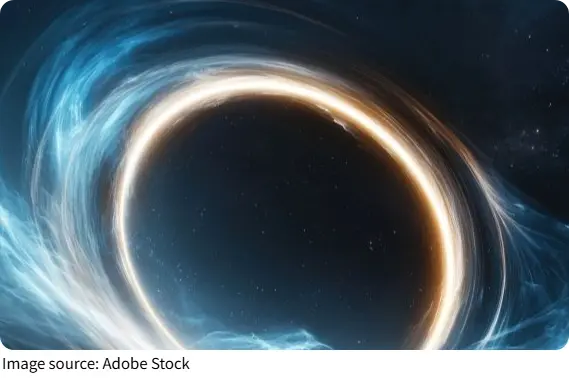
Have you ever imagined a place so dark that not even light can escape?
That's a black hole—a cosmic vacuum with immense gravity, drawing in everything nearby. But here's the twist: despite their name, black holes can actually shine in a way that's nothing short of mesmerizing.
This paradoxical glow is one of the universe's greatest mysteries, and today, we're going to explore how black holes can be both invisible and radiant.
What Makes a Black Hole Glow?
At first glance, the term "black hole" seems to suggest that these cosmic giants are entirely dark. After all, they're formed from collapsing stars that create such a strong gravitational pull that even light can't break free. But black holes aren't purely invisible. In fact, they have a bright side, thanks to a phenomenon known as accretion disks.
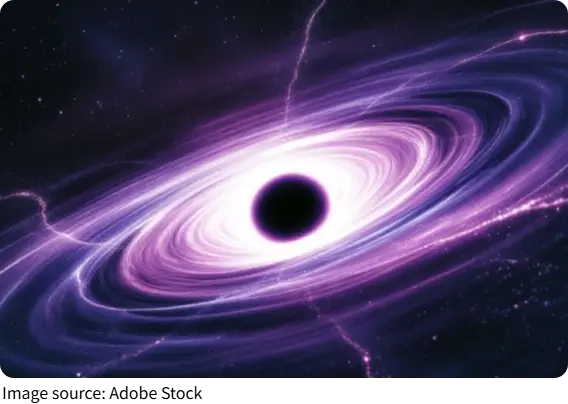
The accretion disk is a spiraling ring of gas and dust that surrounds the black hole. As matter falls into the black hole, it gets heated up to incredible temperatures due to the friction within the disk. This heat causes the matter to emit bright X-rays and light. In some cases, these glowing emissions are so intense that they can be detected billions of light-years away.
Key takeaway: The glow around a black hole is not the black hole itself, but the hot material surrounding it.
The Role of Supermassive Black Holes
Black holes come in different sizes, and the supermassive ones, which reside at the centers of most galaxies, are especially known for their glow. These supermassive black holes can be millions or even billions of times heavier than our sun. As a result, their accretion disks are massive, and the radiation they emit can outshine the combined light of entire galaxies.
For instance, the black hole at the center of the Milky Way, known as Sagittarius A*, doesn't just "eat" material—it also releases bursts of radiation. Though not as bright as some other supermassive black holes, this black hole's glow is still powerful enough for scientists to study from Earth.
Key takeaway: Supermassive black holes' accretion disks are often brighter than the entire galaxy they inhabit.
Hawking Radiation: A Black Hole's Secret Light
You've probably heard of Stephen Hawking, the brilliant physicist who revolutionized our understanding of black holes. One of his most famous theories is that black holes aren't completely "black" after all. He proposed that they could emit faint radiation, now called Hawking radiation. This radiation is due to quantum mechanical effects at the event horizon, the boundary surrounding the black hole.
Though we can't directly observe Hawking radiation yet, it's an intriguing concept. It suggests that even black holes, which are supposed to trap everything inside, might leak energy over time, slowly losing mass and potentially evaporating.
Key takeaway: Even black holes might "glow" faintly over time due to quantum effects.
How Can We See the Glow?
Detecting the light emitted by a black hole isn't as straightforward as pointing a telescope and spotting the source. Since light cannot escape a black hole itself, scientists study the effects of the surrounding material and radiation.
The most well-known method of observing black hole glow is through X-ray telescopes. These telescopes can detect the high-energy light emitted by the accretion disks, as well as the powerful jets of particles that some black holes emit. These jets can be seen shooting out at nearly the speed of light, creating a spectacle that scientists are just beginning to understand.
Key takeaway: X-ray telescopes help scientists see the radiant glow of black holes from afar.
The Impact of Black Hole Light on Our Understanding of the Universe
Understanding how black holes can shine has led to breakthroughs in our knowledge of the universe. The glow from black holes can tell us about the nature of space-time, gravity, and matter itself. It also helps scientists measure the properties of distant galaxies and the supermassive black holes that reside within them.
By studying the light surrounding black holes, astronomers are able to learn more about how galaxies form and evolve. For example, the radiation from supermassive black holes can influence the formation of stars and other cosmic phenomena.
Key takeaway: The light from black holes isn't just pretty to look at—it provides clues about the universe's creation and evolution.
The idea of black holes glowing seems almost contradictory—after all, how can something so powerful and mysterious emit any kind of light? But, as we've seen, black holes shine in more ways than one. From their blazing accretion disks to the faint radiation predicted by Hawking, black holes continue to captivate our imagination. Their glow, whether faint or intense, serves as a cosmic beacon, guiding us to deeper discoveries about the universe.